CLICK: Color Control Color Choice
 Click image to left to view my
recent Iris garden photos
Click image to left to view my
recent Iris garden photos
It all started when a friend laid some wild irises on me from her garden.
I was just starting again- a humble renter with a parking lot full of gravel to garden. I think I had five fresh -looking corms.
Everywhere I have lived I have had success with flags and irises - for instance in a house that I rented I found one or two flags jutting out of the cement walk where they had been thoughtlessly crushed and abandoned.
"I'll separate these knots",I thought -and in no time I had large shining stands of the darned things.
When the first lovely, silken wild iris flowers showed their indigenous glowing souls the second year, I had picked nine million stones and assorted car junk from the developing beds.
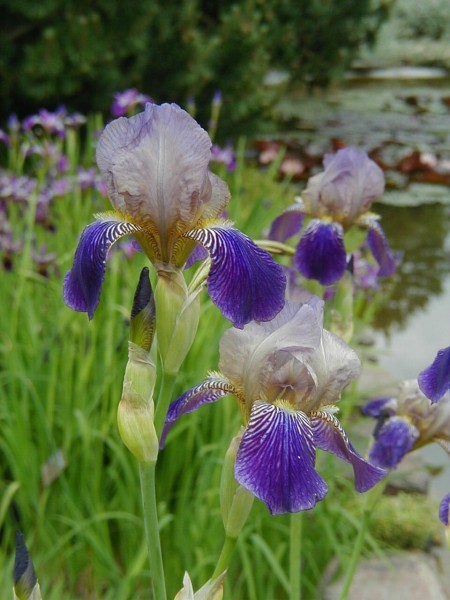
By the time I finished planting and propagating irises, I had a basket of variegated from The Carleton Place Horticultural Society, also some lovely white ones, giant yellow Iris from a friend, purple and mauve bearded wild, and some miniatures in magenta which bloom a little earlier.
Little did I know that after something like five years I would be saying "Take these irises -please". Yep, they propagate in enormous bundles, and need to be thinned every two years or so.
The corms look like lobsters. When I separate mine I carefully relieve the soil of the plant and dip my corm in a bucket of clean, warmish water.
I wash and trim the roots and either send them to a friend or replant in another space.
In July when they have finished flowering, cut irises back to about four inches of leaf to neaten them and to allow the beauty of the next annuals to take shape, leaving the strength in the corm.
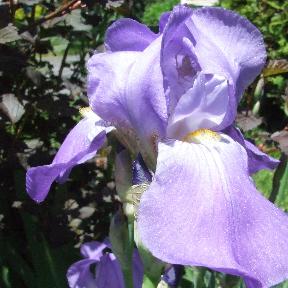
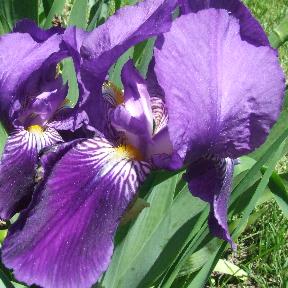
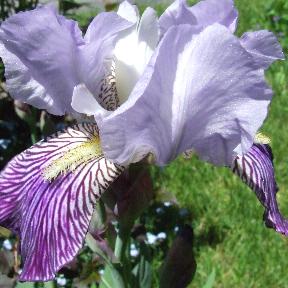 All three Irises shown here grow well in my
garden, yet they are wild water-loving Irises, found near rivers and in
wetland bogs.
All three Irises shown here grow well in my
garden, yet they are wild water-loving Irises, found near rivers and in
wetland bogs.
Each of these Irises are Iris versicolor, the most medicinal of which
is cited by US Pharmaceutical business as the plain light mauve bearded
Iris; European herbal cites the striped variety for herbal medicine.
To explore, see the links below the article.
I have never seen so many blooms on one stem as on this wildflower. How exotic its colour and delicate yellow fur look.
Most of my purple variety yield seven flowers on one stem. I haven't seen this in the wild, and yet the irises one finds by canoe in a duck-weed green shallow live gorgeously in tuffocks that hang out of a perfect water and nutrient supply.
The moral of the story - plant in lots of stone and gravel and add tons of healthy compost and topsoil to this. I also water every two days.
Though the purple blooms every year, the mauve takes a vacation after two years, and does not do so well in the shade. Yes, shade. I went around saying "What can we grow in the shade" so often to myself I was probably interviewed by the RCMP for covert practises!! My wild purple experience grows and blooms even in deep shade. What a lovely plant to work with.
There are hundreds of varieties to explore. What a wonderful sight they make in early summer!

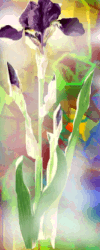 image
of mauve bearded with stripes; click the thumbnail on site.
image
of mauve bearded with stripes; click the thumbnail on site.
Iris versicolor is harvested for its medicinal virtues. A common error is to mistake the Iris Missouriensis for the mauve variety of this medicinal harb. This page shows images of Iris Missouriensis.
L’ris
versicolore (en francais) Iris versicolore
(Iris versicolor)
Famille: Iridacées
Espèce vivace introduite, de taille moyenne (70 cm), qui
affectionne les lieux humides où il pousse en touffes et forme
d’importantes colonies.
L’iris possède de longues feuilles fendues à la base et
imbriquées. Généralement, la tige ne porte qu’une
seule fleur à la fois, de couleur mauve et le rhizome horizontal
est gros et charnu.
Le drainage des terres humides a tendance à faire
régresser son habitat. L’ris versicolore est devenu
l’emblème floral officiel du Québec depuis novembre 1999.
L'image montre un Canada coin, beau à voir, le roulement Quebecs' fleur provinciale sur son visage.
(French translated:, Iris versicolor)Iris versicolore (Iris
versicolor) Family: Iridacées
Type vivace introduced, of average size (70 cm), that is fond of the
humid places where it pushes in bunches and forms important colonies.
The iris possesses long, split leaves to the base, which are
interlocked. Generally, the stem carries only one flower at a time, of
mauve color, and the horizontal rhizome is big and fleshy.
Drainage of the wetlands tends to decline its' habitat. Iris versicolor
became the official flower emblem of Quebec since November 1999.
Image shows a Canada coin, beautiful to behold, bearing Quebecs' provincial flower on its face.
'Kermesina' name of Purple Bearded Blue Flag the striped version is the wild original, according to Czechoslovakian source...
Iris versicolor epidemic! Wetlands enthusiasts see the invasiveness of this Iris as a threat which could dry up wet habitats. These are described as noxious, the way some ecologists have described Dames Rocket (since it is invasive), however each of these plants contributes medicines (like Iridin or Irisin, which are pharmaceuticals for humans, that might be of importance to wildlife.
homeopathy who is right- is it purple, or is it mauve-mauve?
Wikipedia, on Iris
versicolor .."all types of Iris.
bearded is actual Iris by name, bearded, growing from rhizomes.
Limniris is a beardless Iris growing from rhizomes.
Irisin discussion by Susan Scutti suggests that irisin, a medicine made of Iris versicolor, was discovered as late as 2011. I feel this article is a joke, if you find such articles.
Counter to the blogged Irisin discussion